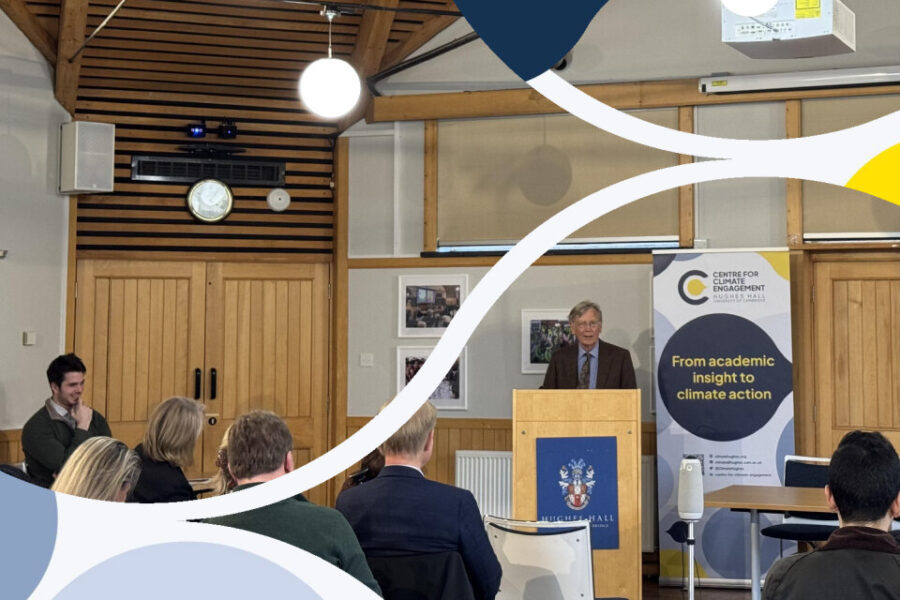
This past Michaelmas Term, the Centre for Climate Engagement (CCE) hosted the first four events of the second annual Cambridge Seminar Series on Law and the Climate Crisis. Developed by University of Cambridge Hatton Professor of Climate Law, Harro van Asselt, the series aims to showcase how climate change interacts with specific areas of law, setting out both how legal fields are being impacted by climate change and how the law can help drive climate action.
The events focused on a range of legal topics and featured an array of speakers from across academia and practice. The term’s speakers and events were:
- Lord Robert Carnwath CVO on Judges and Climate Change
- Harj Narulla on Reparations and Climate Change
- Professor Ernest Lim on Corporate Law and Climate Change
- Matthew Gingell on Contract Law and Climate Change
Key takeaways from each of the four seminars are provided below.
Together with the CCE, the Cambridge Seminar Series on Law and the Climate Crisis is co-hosted by Cambridge Zero, the Centre for Environment, Energy and Natural Resource Governance (C-EENRG), the Cambridge Climate Society, the Lauterpacht Centre for International Law, and the Cambridge University Law Society – whom we thank for their continued support in delivering these events.
Judges and Climate Change

The first event of the term welcomed Lord Robert Carnwath CVO, former UK Supreme Court Justice. Lord Carnwath reflected on the rapid growth of climate-related litigation and examined how courts across different jurisdictions are navigating questions of judicial independence, activism, and responsibility. Throughout his career, Lord Carnwath has been involved in international initiatives, including the EU Forum of Judges for the Environment and the Global Judicial Institute on the Environment, which aim to enhance judicial understanding of environmental issues and promote knowledge sharing. He emphasised that active engagement with environmental challenges is not at odds with judicial independence, though he acknowledged that some legal systems adopt a much stricter approach.
In Norway, a 2020 Supreme Court case challenging Arctic oil exploration led to a judge being excluded due to perceived environmental sympathies, providing a key example of more rigid approaches to judicial impartiality in climate-relevant cases. By contrast, Lord Carnwath explained that courts in India and Pakistan have shown greater leniency, such as in a case concerning the Great Indian Bustard (MK Ranjitsinh v. Union of India). The 2021 landmark Supreme Court ruling in favour of protecting the critically endangered bird from habitat loss was presided over by Chief Justice Chandrachud, a vocal advocate of courts’ capacity to help address climate change. Lord Carnwath emphasised that various courts have endorsed the idea of an “environmental rule of law”, demonstrating a willingness to engage robustly with climate and environmental protection, while still operating within constitutional boundaries. In these cases, judges are not acting outside the law but are instead using existing legal frameworks creatively and purposefully.
“One of the strengths of the plenary court is that it brings together judges with different specialisations and points of view and allows for constructive debate between them.”
Lord Carnwath referenced influential cases from other jurisdictions, including Chief Judge Brian Preston’s 2019 Gloucester Resources decision in New South Wales, which considered downstream emissions from coal use, as well as Juliana v United States. Throughout his examination of these cases, Lord Carnwath dismissed the idea that meaningful judicial engagement with climate change requires radical activism, suggesting instead that courts can play an important role simply by holding governments to their own stated climate policies, while respecting the separation of powers. In closing, Lord Carnwath urged caution against sweeping generalisations, highlighting the importance of legal and constitutional context. He encouraged judges to reflect on the wider impact of their decisions, while continuing to uphold objectivity and judicial independence in the face of the climate crisis.
Reparations and Climate Change
In the second seminar, Harj Narulla examined the concept of climate change reparations in international law. Barrister at Doughty Street Chambers and an experienced international advocate, Narulla drew on his involvement in major advisory opinion proceedings – including his role as counsel for the Solomon Islands before the International Court of Justice (ICJ) – to explore the growing legal significance of advisory opinions and their practical implications.
Narulla emphasised that advisory opinions, although formally non-binding, play a critical role in shaping the international legal landscape. While advisory proceedings differ from contentious cases, they allow international courts to articulate general principles and interpret the obligations of states. These interpretations clarify the content of existing legal duties, including obligations under the Paris Agreement (which is binding on all member states). Narulla explained that advisory opinions offer an important guide to how international courts are likely to approach future contentious climate cases.

A central theme was the importance of how questions are framed when put to international courts. Narulla traced four advisory proceedings chronologically, highlighting how different framings have produced distinct but generally complementary outcomes. In 2024, the International Tribunal for the Law of the Sea (ITLOS) found that greenhouse gas emissions constitute marine pollution under the United Nations Convention on the Law of the Sea (UNCLOS), rejecting arguments that climate obligations should be assessed only within specialised legal regimes. The advisory opinion of the Inter-American Court of Human Rights (IACHR) opinion went further still. Addressing nearly 30 questions, the court considered both state obligations and responsibility, including reparations. Narulla noted that the decision suggests that climate protection is a peremptory (jus cogens) norm and affirmed a right to a healthy climate as part of the right to a healthy environment. This marked a significant development, extending legal recognition to the protection of nature itself and allowing claims based on extraterritorial climate harm. The opinion also confirmed that states have a duty to mitigate greenhouse gas emissions.
The ICJ advisory opinion built on this momentum, focusing on states’ obligations across various sources of international law. Narulla highlighted its interpretation of the 1.5°C emissions target as a concrete legal standard, rather than solely a multilateral policy objective. The court also singled out support for fossil fuels as a source of potential breaches of international law and confirmed that even states that have withdrawn from the Paris Agreement remain retain international obligations to reduce emissions. Crucially, the ICJ affirmed that the full range of legal consequences for wrongful acts is available in the climate context, including cessation and non-repetition – potentially requiring the repeal of laws and regulatory reforms – as well as reparations in the form of restitution, compensation, and satisfaction.
While the ICJ has historically awarded relatively modest sums in reparations – its highest compensation award to date being US$ 375 million – analysis suggests that compensation owed by the Global North to the Global South for exceeding fair carbon budgets could well exceed this amount, potentially reaching figures as high as US$ 192 trillion by 2050. However, practical and political constraints remain: only 74 states have accepted the ICJ’s compulsory jurisdiction – which excludes several major economies and fossil fuel producers. Further, building a reparations case involves a substantial evidentiary burden, including complex climate attribution science and the challenge of quantifying state-specific harm. Despite these challenges, Narulla suggests that the ICJ advisory opinion is likely to influence future litigation, though cases will be resource-intensive and technically demanding. He highlighted ongoing challenges in aligning legal frameworks with climate policy goals, the dynamics of common but differentiated responsibilities, and the need to rely on collective forums to overcome barriers to entry in inter-state climate litigation.
Corporate Law and Climate Change
The third seminar, on corporate law and climate change, featured Professor Ernest Lim, Professor of Law and Vice Dean of the National University of Singapore’s Faculty of Law. This session focused on directors’ duties in the context of climate change and corporate law, drawing on research from the forthcoming Oxford Handbook of Climate Change and Private Law due to be published in May 2026. Lim explored how climate change is challenging the traditional, internally focused understanding of directors’ duties and pushing corporate law to grapple with firms’ external environmental impacts.
“If boards continue to focus exclusively or primarily on financial materiality, there is a risk of companies causing more externalities. So, we should think about how we can use corporate law to require boards to internalise negative externalities.”

Lim framed directors’ duties around a divide between an internal dimension, encompassing traditional conceptions of fiduciary obligations , and an external dimension, which concerns how corporate decision-making creates environmental and social externalities. He argued that this external dimension is gaining legal significance for a range of reasons. A growing understanding of ‘universal ownership’, which describes diversified investors bearing the systemic costs of climate harm across their portfolios, is putting pressure on companies to address their own contribution to climate change, as seen in McRitchie v Zuckerberg. The evolving EU framework under the Corporate Sustainability Due Diligence Directive and Corporate Sustainability Reporting Directive), though imposing duties on companies rather than directors, generally push the “environment of expectation” for directors to higher standards – an effect complicated by the EU’s now-ratified Omnibus proposals.
The extent to which directors should internalise negative environmental externalities can be limited by the perceived risk that this may reduce firm-specific shareholder value. Empirical research, including work by Shapira and Zingales, suggests that pollution can be value-maximising in the short term, highlighting a real trade-off between profitability and internalising environmental costs. Lim discussed the concept of double materiality, distinguishing between financial materiality and impact materiality, and warned that an exclusive focus on financial materiality risks exacerbating corporate-driven environmental harm. Enforcement of corporate responsibility also remains difficult; while courts are reluctant to second-guess boards, cases such as ClientEarth v. Shell show that they may still scrutinise processes, including climate risk oversight. Ultimately, Lim argued that failure to internalise externalities can damage overall portfolio value – an issue of particular concern for institutional and universal owners. He also pointed to the limitations of existing mechanisms – regulation, market discipline, and litigation – to illustrate how all three can fail to constrain corporate misconduct.
In considering where there is real opportunity for impact, Lim highlighted the significance of state-owned enterprises (SOEs), which often operate under mandates extending beyond profit maximisation. He noted that 13 of the world’s top 20 carbon majors are SOEs, but also that SOEs account for over half of planned global renewable energy investment. It was suggested that where the state acts as both controlling shareholder and asset owner, fiduciary duties can more readily align with climate and public interest objectives, which could have significant impact in high-emitting, SOE-dominated countries including China. However, Lim concluded there remain fundamental tensions over attributing where responsibility for climate impacts should be directed, and the debate continues to be a live and contested issue.
Contract Law and Climate Change
The fourth event of the series focused on contract law and climate change. Matthew Gingell, General Counsel at Oxygen House and founder of the Chancery Lane Project, focused on the often-overlooked power of contract law in addressing climate change, and the potential to utilise core legal skills in contract drafting to advance sustainability and purpose-driven climate action.
Gingell characterised contracts as one of the four key legal levers for climate change, alongside legislation, litigation, and governance. While these must function as an interconnected system, contracts are especially powerful considering that they govern almost all of the global economy, and that every contract has emissions embedded within it. Poorly designed contracts can lock in high-emissions behaviour, whereas well-designed ones can actively drive decarbonisation. Shifting contractual practice, Gingell argued, can generate a positive feedback loop – reshaping markets, supporting more ambitious legislation, and accelerating climate action from the bottom up. Unlike legislation, which can take years to enact and even longer to come into force, contracts can be drafted, implemented, and deployed rapidly.

A recurring theme was the inflexibility of traditional contract law concepts when applied to the climate crisis. Standard mechanisms, e.g. liquidated damages, are poorly suited to environmental harm, and long-standing precedents have contributed to a legal ecosystem that struggles to accommodate the need for rapid transition. Gingell explained that contract law has remained relatively static, and that lawyers must innovate around existing structures rather than treating precedent as immovable. At the same time, precedent is precisely what gives contracts their power. Gingell described contracts as an “under-the-radar” deployment mechanism for climate solutions: by embedding emissions considerations into everyday agreements, lawyers can oblige emissions reductions, encourage better behaviour, and rewire economic relationships. Examples include green lease provisions, incentivisation clauses that reward positive conduct rather than relying on breach-based penalties, and contractual arrangements that share the costs and benefits of climate-positive transformation across supply chains.
The critical importance of supply chain sustainability was emphasised, with the suggestion that the next wave of climate litigation is likely to be intra-supply chain disputes. Gingell reflected on moments of disruption that expose contractual shortcomings. During COVID-19, widespread reliance on force majeure clauses revealed how contracts can be reimagined in times of crisis, with some evidence of climate-sensitive force majeure clauses being implemented to allow exit only where local environmental harm to ecosystems is avoided. However, he cautioned that nature and biodiversity impacts do not reduce neatly into a quantifiable emissions metric, making climate-conscious drafting inherently complex – highlighting the need for cooperation within and across sectors. Ultimately, contracts are “professionally and politically neutral”, yet deeply influential. By changing market norms through novel drafting practices, commercial pressure, and coordinated action across industries, contract lawyers can drive meaningful climate action.
Looking Ahead
The CCE would like to thank last term’s speakers for fostering meaningful dialogue on how law can shape a sustainable future, and how legal research, including that which is taking place at the CCE, can better enable climate action.
The seminar series will continue in the Lent Term with the following events:
- 6 February 2026 – Dr Ugljesa Grusic (University College London), Private International Law and Climate Change
- 13 February 2025 – Dr Hao Zhang (Chinese University of Hong Kong), Energy Law and Climate Change Mitigation in China
- 20 February 2025 – Dr Pedro Schilling de Carvalho (University College London), Financial Law and Climate Change
- 27 February 2025 – Dr Franziska Arnold-Dwyer (University College London), Insurance Law and Climate Change
These events are open to the public. The CCE welcomes you to attend and learn more about our work across policy, law, and governance. We also greatly welcome any thoughts on future topics for this seminar series and ideas for collaboration, which you can share by emailing climate@hughes.cam.ac.uk or by getting in touch with one of our team members directly.
 Slingshot