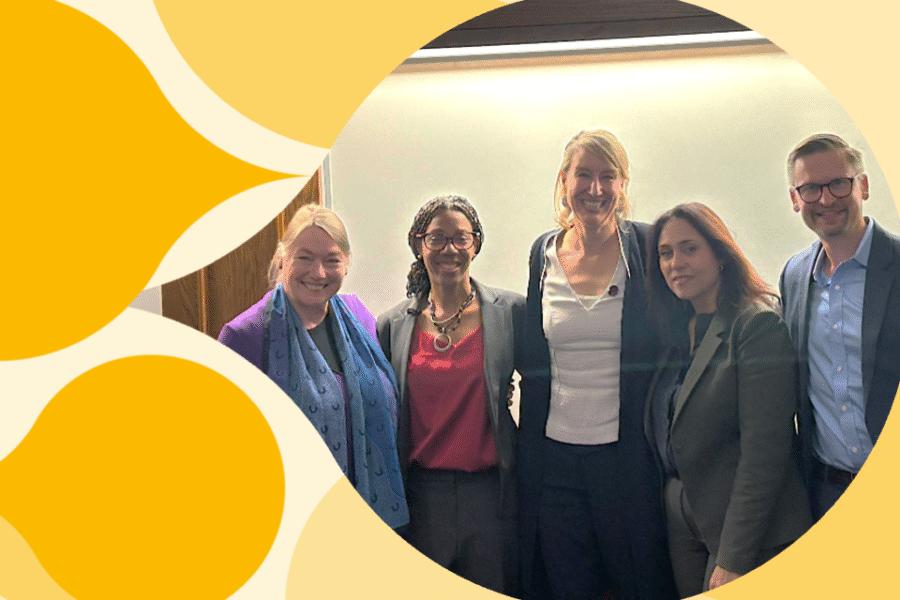
On Monday 10 November 2025, Cambridge University Press (CUP) and the Centre for Climate Engagement (CCE) hosted an online panel and roundtable discussion to mark the launch of the new open access journal, the Cambridge Forum on Corporate Climate Governance.
Moderated by CCE’s Dr Eldrid Herrington, the panel was hosted at the University of Pennsylvania and brought all together all five of the journal’s Editors-in-Chief.
Panel:
- Lisa M. Fairfax, Penn Carey Law, University of Pennsylvania, USA.
- Eldrid Herrington, Centre for Climate Engagement, Hughes Hall, University of Cambridge, UK.
- Sherwat Elwan Ibrahim, The American University in Cairo, Egypt
- Jane Nelson, Corporate Responsibility Initiative, Harvard Kennedy School, USA.
- Dan W. Puchniak, Centre for Commercial Law in Asia, Singapore Management University, Singapore
Key points discussed:
A Journal built for Impact
Open access, multidisciplinary, global perspectives, plain language, and designed for both academics and practitioners across law, finance, business, policy, and related fields. The journal is for everyone shaping climate action, by highlighting actionable research and thought leadership on corporate climate governance.
Governance lens and accountability
The Editors stressed that climate responses must be understood through a governance lens: how boards make decisions, allocate power, and are held accountable. Without robust governance structures, even strong environmental policies risk remaining “smoke and mirrors” rather than being implemented and monitored.
Breaking silos and fostering dialogue
A key theme was the need to break down silos—within academia, within corporations, and between disciplines. The journal aims to connect those “on the ground” (boards, regulators, investors, NGOs) with those studying these issues, creating two-way learning rather than an “ivory tower” conversation.
Global and inclusive perspectives
The Editors emphasised that climate governance needs perspective from every region. Asia and Africa, in particular, must be central given their populations, markets, biodiversity, and lived experience of climate impacts. The journal will actively seek work led by local scholars and practitioners from the “global majority”.
Equity, diversity, and just transition
Diversity in boards and authorship was framed as essential for avoiding blind spots and capturing new opportunities. The journal will foreground issues of equity, human rights, and just transition, recognising that climate impacts and climate policies create winners and losers, and do not affect all communities equally.
Nexus issues: climate–energy–nature–people
The discussion highlighted the complexity of “nexus” issues: climate’s interaction with energy systems, biodiversity, water, jobs, and livelihoods. Boards increasingly need integrated approaches that treat mitigation, adaptation, energy security, and social impacts as connected governance challenges.
Board oversight, strategy, and structures
For Boards, climate is no longer a one-off sustainability agenda item but a recurring topic for audit, risk, remuneration, and nomination committees. The Editors discussed the growing responsibility of boards to oversee climate strategy and opportunities for value creation. By developing new skills, structures, and incentive systems, Boards are positioning their organisations for long-term success.
Plain language and accessibility
Several speakers stressed the importance of plain language so that complex climate and governance issues are understandable across disciplines and professions. Rigour and sophistication are preserved, but jargon is reduced to enable wider engagement and practical use.
Call for contributions and next steps
The editors announced an inaugural issue and a follow-up special issue on climate finance. They invited submissions, proposals for guest-edited issues, and ideas for a “state of the art” section, emphasising that the journal’s direction will be shaped by the community that engages with it.
“Climate change affects us all, and overcoming it requires breaking down silos and inequalities. I am committed to making each issue of this journal as global as possible, amplifying voices from every continent.Our aim is to bring the best available evidence to the vital question of how corporations and their wider ecosystems can respond to climate change. One of the most powerful ways we do this is by cultivating global conversations—linking academics, lawyers, non-executive directors, stock exchanges, banks, investors, regulators, policymakers, and NGOs.”
Dr Eldrid Herrington
 Slingshot