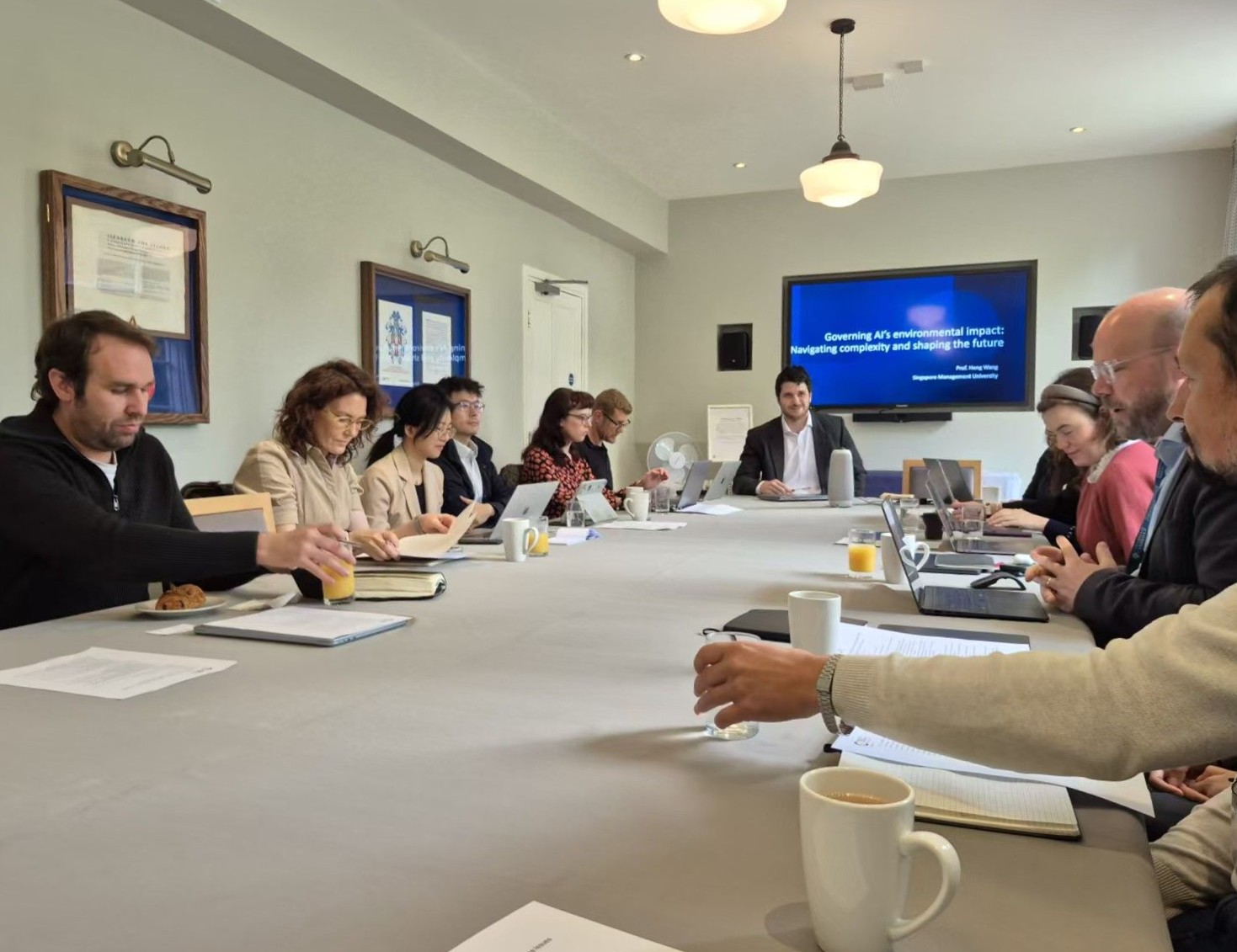
On 5 May 2026, the CCE’s Law for Climate Action hosted a roundtable discussion on AI and environmental governance at Hughes Hall, Cambridge.
Professor Heng Wang (LinkedIn) from Singapore Management University (SMU), a globally renowned expert in technology law and international economic law, gave a keynote presentation at the start of the roundtable, which was chaired by Professor Harro Van Asselt, Hatton Professor of Climate Law at the University of Cambridge.
During his presentation, Professor Wang explored issues at the intersection of AI, governance and the environment, including:
- Navigating complexity: AI’s environmental footprint is fundamentally complex – spanning energy consumption, water use, hardware lifecycles, and indirect emissions across global supply chains. This complexity creates regulatory challenges related to measurement, attribution, and enforcement, and existing environmental regulation was not designed with AI technologies in mind. Yet data centres are developing at pace and AI capabilities are advancing faster than governance frameworks can adapt, making delay increasingly costly. The window to shape the industry’s trajectory is closing.
- Investment levers: Commercial incentives for responsible AI development remain poorly aligned with environmental outcomes. Until environmental risk is priced into investment decisions and customer agreements, the market will continue to reward speed over responsibility. Investors are increasingly attaching their own reporting and sustainability expectations, and there is growing recognition that investment could serve as a powerful lever for driving better environmental outcomes from AI companies – but this potential remains largely unrealised. Regulatory intervention remains a primary mechanism for closing the gap.
- Building public trust in AI: Users – individuals, firms, and/or governments – are central to how AI regulation takes shape in practice. The rise of agentic AI introduces a range of new due diligence concerns. An effective regulatory response matters beyond the environmental question – it is increasingly tied to questions of international security and public confidence in AI systems more broadly. Without trust, the governance structures needed to manage AI’s environmental impact will lack legitimacy.
- A holistic governance approach: Designing effective AI environmental regulation may draw on existing environmental regulatory approaches. One such example is the international whaling regime, and how global consensus around a shared environmental risk was over time codified into binding governance. Drawing on lessons from such existing frameworks could help policymakers avoid reinventing the wheel and build a more durable, internationally coherent and efficient regulatory response.
View Professor Wang’s lecture below:
“AI is moving faster than many governance systems can adapt. To reap its benefits in an environmentally responsible way, we need creative approaches that align incentives, close governance mismatches, and build trust. Many thanks to Mr Nick Scott, Professor Harro van Asselt and the CCE for the opportunity to give the keynote at Cambridge, and for opening space for collaboration with colleagues in Cambridge and beyond.”
Professor Heng Wang, SMU
Following Heng’s presentation, attendees at the roundtable discussion drew on expertise from academia, practice and industry to identify further governance implications of AI’s environmental impacts. Key themes included:
- Interaction with existing legal frameworks: Discussion explored whether AI’s environmental impact demands entirely new legal architecture or whether existing tools including reporting and disclosure frameworks and energy market regulation can absorb much of the challenge. There was broad agreement that policy solutions require sensitivity to national contexts, and that greater conceptual clarity is needed. Considerations raised include what exactly counts as an AI-related environmental impact, where in the AI lifecycle it occurs, and how to weigh short-term emissions and energy demand from model training against potential long-term efficiency gains. These considerations have begun to surface in litigation, suggesting that in the absence of clearer frameworks, challenges under existing legal frameworks such as planning and permitting law may become a significant driver of accountability.
- Emerging regulation: A fragmented landscape is taking shape globally – from data centre-specific EIA requirements in select US states, Singapore’s proposed Digital Infrastructure Act (DIA), China’s data centre carbon emissions assessment requirements, to international voluntary standards (e.g. ISO 20226). There remain challenges to market-led approaches, including the lack of established mechanisms to meaningfully price AI systems’ environmental risks. A further concern is the risk of regulatory capture due to asymmetry between well-resourced industry actors and under-equipped regulators. Underpinning this is a need to democratise data on AI usage, to ensure that emerging regulation accurately reflects and responds to the real-world impact pathways of these technologies, rather than the interests of those best placed to shape it. With better understanding of where and how these impacts manifest, well-designed economic incentives and disincentives may help to ensure that firms, regulators, and end users alike account for AI-related environmental liabilities.
- Ways forward: Attendees called for a blend of transparency, disclosure, and aligned commercial incentives rather than regulation alone. Practically, this involves anchoring governance across levels of government to avoid siloed national responses, embedding environmental goals into model development from the outset, and promoting green AI and its use for solving environmental problems as a competitive advantage. Until clearer standards emerge around what counts as credible disclosure, greenwashing risk will continue to undermine both investor confidence and the broader case for using AI in climate-related work.
We would like to thank the following individuals for participating at the roundtable event:
Alexey Noskov (University of Cambridge); Aray Serikzhanova (Chapter Zero Kazakhstan); Beichen Ding (University of Bern World Trade Institute); Benoit Mayer (University of Reading); Calum Handforth (UNDP); Christian Diaz-Ordonez (University of Cambridge); Devorah West (Tony Blair Institute); Emily Bradeen (LSE Grantham Institute); Guillermo Miranda Garcia (independent legal professional); Hao Zhang (Chinese University of Hong Kong); Henning Grosse Ruse-Khan (University of Cambridge); Isobel Morris (Cambridge Zero); Jenny Murray (Bird & Bird); Jin Qin (University of Cambridge); Jiujing Ye (King’s College London); Nick Scott (CCE); Peter Lee (Simmons & Simmons); Philippa Martinelli (Cambridge Centre for Alternative Finance); Sofie Surraco (CCE)
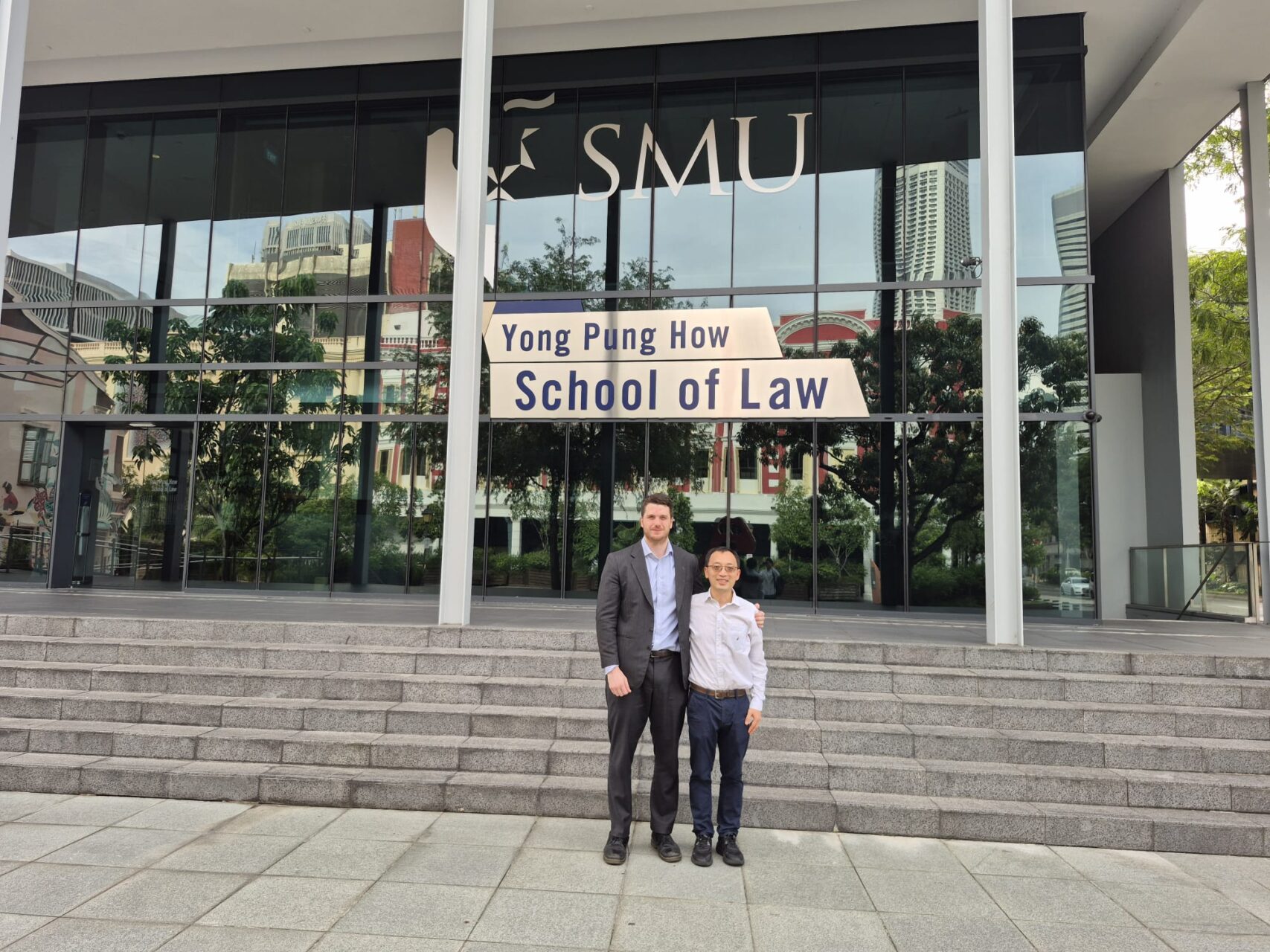
A few weeks after Professor Wang’s visit, Nick Scott joined SMU’s Yong Pung How School of Law for a short period as a visiting scholar. This visit built on the roundtable discussion, setting the stage for further collaborative research and engagement between SMU and Hughes Hall.
By coordinating research, synthesising findings into practical briefings and resources, and convening leading experts in the topic, this collaboration aims to provide crucial and timely guidance on how governance can ensure AI development and use aligns with climate goals.
“Aligning AI governance with environmental goals is a complex challenge that requires global collaboration between researchers, industry, and governments. It has been very exciting to start exploring these issues with international partners, and I am extremely grateful to Professor Wang and the Yong Pung How School of Law for facilitating a great visit to SMU.”
Nick Scott, Programme Lead (Law for Climate Action)