The Law & Climate Atlas provides clear, accessible insights into how climate change is influencing different areas of law, and how legal frameworks can help drive climate action. This free online resource has now been expanded to include three areas of EU law, and four additional sections covering Brazilian law.
Developed by the Centre for Climate Engagement (CCE) at Hughes Hall, University of Cambridge, and the Net Zero Lawyers Alliance (NZLA), the Law & Climate Atlas is a free online tool for anyone wishing to understand the impact of climate change on specific practice areas.
The Atlas draws on hundreds of cases, statutes, and research papers to produce succinct overviews that illustrate how climate issues are reshaping legal practice and highlight the vital role of lawyers in supporting the transition to a net zero and climate-resilient economy. Available at lawclimateatlas.org, the Atlas explores key fields, such as human rights, securities and finance, tort, contract, antitrust, international trade, taxation, and supply chain considerations across multiple jurisdictions.
We are delighted to share the continued expansion of the Atlas, which now includes the European Union.
The EU is a global leader in climate governance, implementing laws and policies that have an influence far beyond the bloc’s borders. In addition to its large body of climate-focused legislation, the EU has embedded climate change into the way it regulates firms, assesses public decision making, and trades with other jurisdictions. NGOs and citizens have leveraged longstanding legal frameworks to advance climate goals through environmental litigation. At the same time, geopolitical tensions and economic challenges have created political headwinds for climate policy in much of Europe. For legal professionals working in the EU, understanding the complex relationships between climate change and law is crucial – and the Atlas’s new expansion into the EU provides a platform to do so.
The European edition of the Atlas includes chapters on the following areas of law:
- Competition Law
- Investment Treaty Arbitration
- Trade Law
The Brazilian edition of the Atlas also continues to grow. Launched during COP30, the expansion of this section reflects the acceleration of climate policy in Brazil and the proliferation of climate-related litigation against both public and private actors.
The latest Brazilian chapters cover the following areas of law in Brazil:
- Company Law
- Environmental Law
- Public International Law
- Tax Law
We would like to thank all those who have contributed to the latest additions to the Atlas. This includes, Mattos Filho, Trench Rossi Watanabe and Baker McKenzie, as well as our expert reviewers.1
1 Trench Rossi Watanabe and Baker McKenzie have executed a strategic cooperation agreement for consulting on foreign law.
“Combatting climate change is a constitutional objective of the European Union (EU). The EU has become one of the most prolific and consequential producers of climate-relevant law anywhere in the world and its reach extends well beyond its own borders. I am delighted that Hughes Hall’s Atlas is now extending into EU law: practitioners, students and policymakers urgently need a clear, trusted entry point into this fast-moving landscape, and the new chapters will sit alongside the existing UK, US and Brazil materials in ways that should make cross-jurisdictional comparison considerably easier. This is, I hope, a significant further step on the Atlas’s journey towards becoming a truly global resource and impacting on legal work anywhere in the world in the interest of climate change.“
Markus Gehring, Professor of European and International Law, University of Cambridge
“The Law and Climate Atlas is a fantastic resource showcasing how this might be done.
Marike van Kooten, Lawyer and Legal Advisor, Provincie Groningen
My own area, competition law, is no exception and the chapter on competition law and climate change shows how sustainability is relevant to the prohibition on anticompetitive agreements, abuse of dominance, and merger control.”
“Climate change is an existential crisis and we must use every tool and policy available to combat it. The law is a very powerful tool and where it can be used we have a moral duty to use it. The Law and Climate Atlas is a fantastic resource showcasing how this might be done.
My own area, competition law, is no exception and the chapter on competition law and climate change shows how sustainability is relevant to the prohibition on anticompetitive agreements, abuse of dominance, and merger control.“
Simon Holmes, Visiting Professor of Law at Oxford University and Judge at the Competition Appeal Tribunal
“Understanding how climate change intersects with different areas of law requires both comprehensive data on law and policies that explicitly target climate change and data on how existing legal frameworks operate in the climate context in practice. The Law and Climate Atlas is a brilliant resource for anyone trying to understand the legal landscape — it offers accessible, jurisdiction-specific analysis across an impressive range of practice areas. The expansion into EU law and additional Brazilian chapters is particularly timely, and I hope it will prove a valuable companion resource to the Climate Change Laws of the World database, which tracks national-level climate legislation and policy across 196 jurisdictions including the EU. Together, resources like these help lawyers, policymakers, and researchers navigate an increasingly complex legal landscape.“
Catherine Higham, Senior Policy Fellow, The LSE Grantham Research Institute
About the Law and Climate Atlas
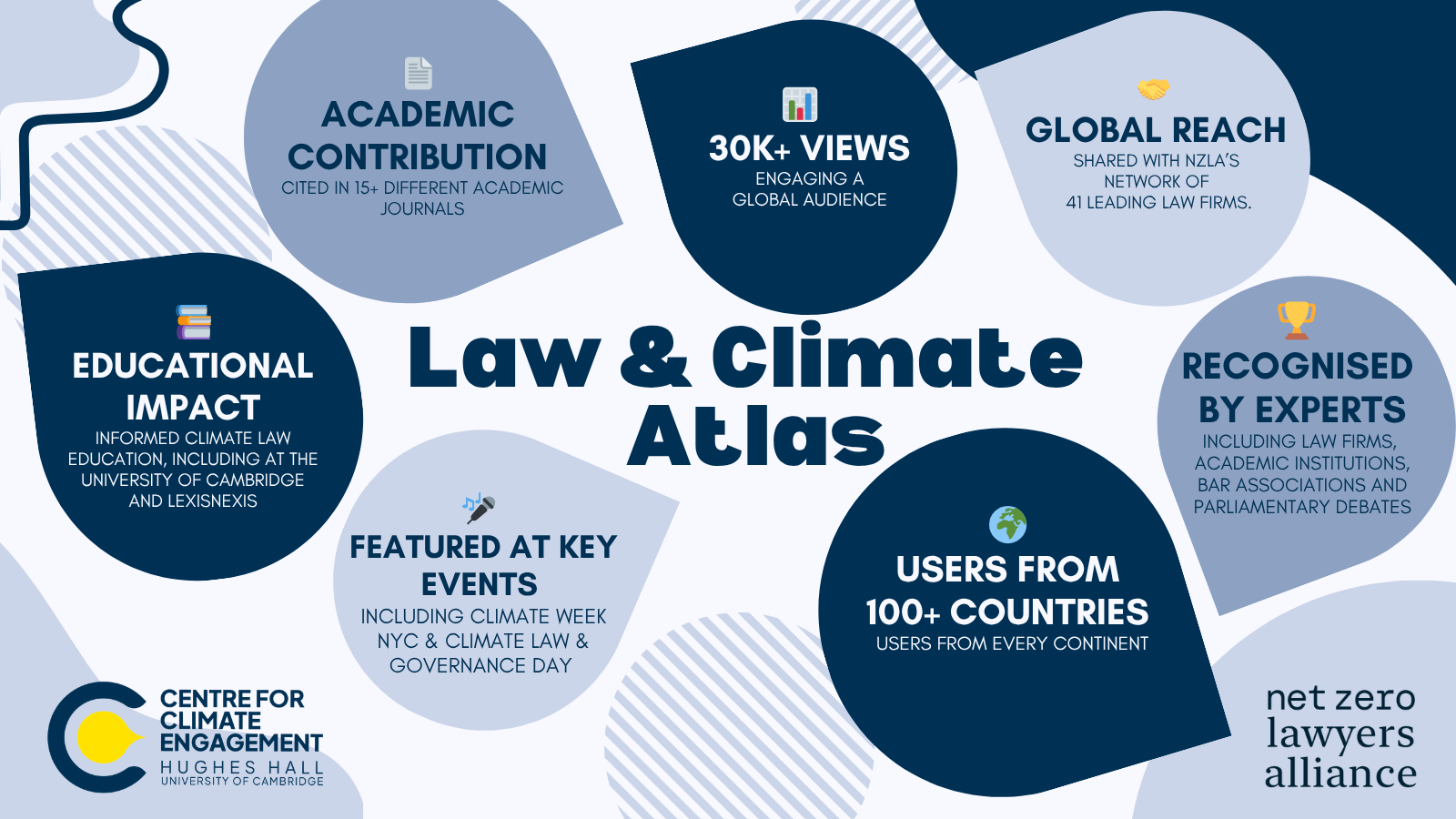
The Atlas launched in Summer 2022, with 16 chapters focused on the UK. Since then, the Atlas has expanded to include more practice areas and additional jurisdictions, as well as globally significant developments. The Atlas now includes 53 chapters across the UK, the US, Brazil, and the EU.
The Atlas has been showcased at leading climate and legal events, including COP27, COP28, London Climate Action Week, New York Climate Week, IBA Annual Conferences, PreCOP29, and the UNFCCC SB62 in Bonn. Panels have been hosted by the International Bar Association, UNFCCC, American Bar Association, Brazilian Bar Association, CISDL Secretariat, and King’s College London.
It has over 30,000 views from users across 100+ countries. In addition to being used in day-to-day practice, the Atlas is frequently used to build the climate change capability of legal professionals. For example, the Atlas is:
- available through LexisNexis
- actively used at the University of Cambridge
- an input into The Chancery Lane Project’s practical training
- used to build capacity within law firms
- featured in CPD-accredited sessions with bar associations worldwide.
Cited in 15+ academic journals, listed on the IBA Climate Registry and featured in professional publications, the Atlas is a trusted, authoritative resource advancing climate-competent legal practice globally.
The CCE plans to expand the Atlas to other regions in the future and welcomes expressions of interest from possible international collaborators.