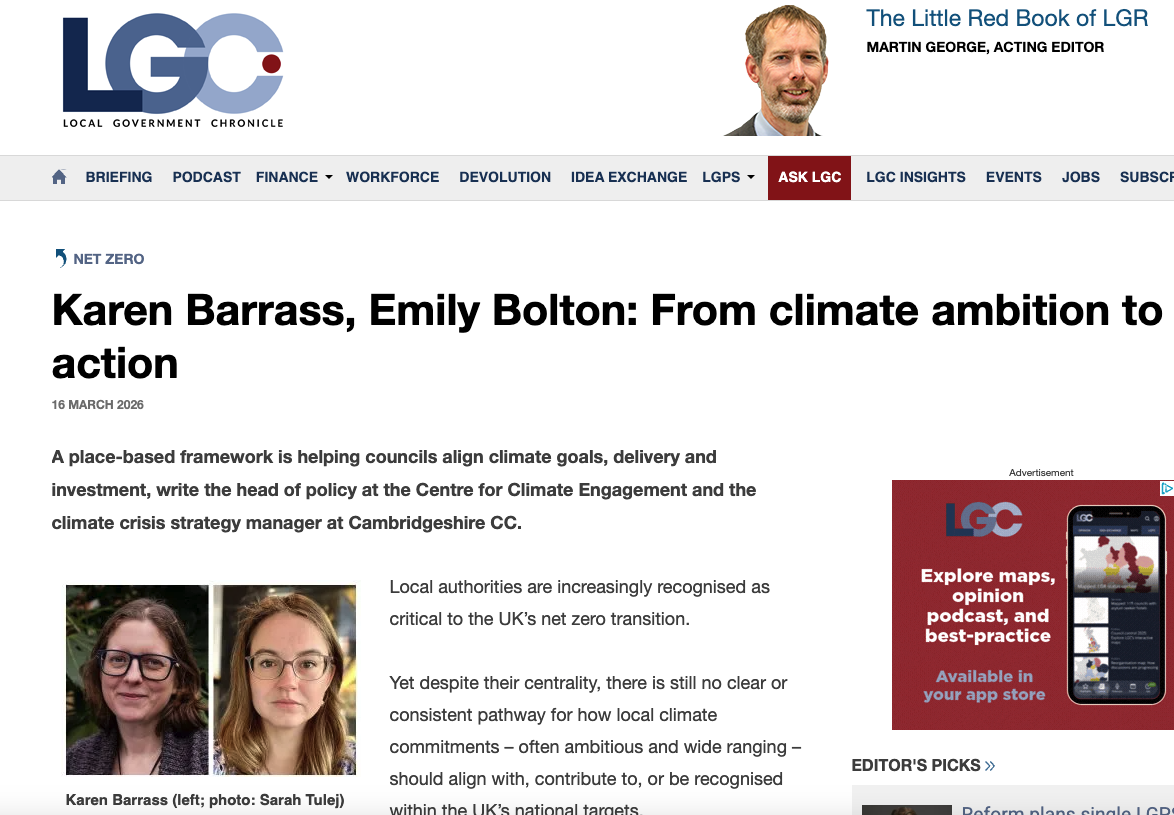
The Centre for Climate Engagement (CCE) and Cambridgeshire County Council have co-authored an article for the Local Government Chronicle on their Locally Determined Contributions (LDC) project, a toolkit designed to support place-specific, realistic and transparent climate targets.
The article was written by Dr Karen Barrass, Head of Policy at CCE, and Emily Bolton, Climate Change Strategy Manager at the council.


A longer version of the article appears below, and includes all partner quotes.
Locally Determined Contributions: turning climate ambition into deliverable local action
A place-based framework is helping councils align climate goals, delivery and investment, write the head of policy at the Centre for Climate Engagement and the climate crisis strategy manager at Cambridgeshire CC.
Introduction: the local delivery gap
Local authorities are increasingly recognised as critical to the UK’s net zero transition. They are the level of government closest to communities, businesses and place-based systems, and therefore play a vital, irreplaceable role in turning national climate ambition into real-world delivery. Yet despite their centrality, there is still no clear or consistent pathway for how local climate commitments – often ambitious and wide ranging – should align with, contribute to, or be recognised within the UK’s national targets.
Councils hold influence over some of the most critical emissions sources, including planning and land use, transport and highways, housing, energy infrastructure, and the ability to convene local partners. However, many still face uncertainty about where their direct control ends, where their wider influence begins, and how local powers and responsibilities interact with national policy, data and funding structures. This ambiguity slows action, fragments investment and makes it harder for places to
To address this gap, the Centre for Climate Engagement (CCE), Cambridgeshire County Council (CCC) and its local authority partners, have collaboratively developed the Locally Determined Contributions (LDC) approach. Funded through Innovate UK’s Net Zero Living Programme, the toolkit enables place-specific, realistic and transparent targets to be consistently developed and aligned with national net zero goals.
What are LDCs and why they matter
LDCs take inspiration from Nationally Determined Contributions under the Paris Agreement but are designed specifically for places. They provide a structured way for councils to set out how local emissions reductions can be achieved within existing powers and partnerships, while clearly identifying where national action or additional resources are required.
By aligning local and national data, evidence and practices, LDCs help councils make far stronger strategic cases for action. They provide clarity and transparency about the areas where local authorities can genuinely lead and avoid placing responsibility on councils for emissions, sources they have no control or limited influence over. This more accurate picture of local climate responsibility gives businesses and delivery partners greater certainty, and supports the development of credible, investable climate action plans
From concept to practice: developing and testing the toolkit
The LDC toolkit was developed through close collaboration with officers from CCC and constituent local authorities. It takes local authorities from understanding their control over policy areas, to target setting and developing an investment proposition. It is not intended to be prescriptive, allowing each local area an opportunity to build their LDC as appropriate, but is guided by 10 overarching principles for consideration. The 6 sections of the LDC toolkit are as follows:
- Guiding Principles: setting out what makes a robust LDC
- Influence mapping: methodology for identifying where a Council has most influence or control over emissions within its geography
- Carbon budgeting: discussing approaches to identifying a local carbon budget
- Action pathways: setting out how to translate your influence map and carbon budget into actionable delivery pathways
- Co-benefits: discussing how co-benefits can be used to support action prioritisation
- Investment: discussing how to use the LDC to leverage inward investment into your place
Much of the information signposts local authorities to existing guidance. The influence mapping approach was designed through the project to understanding where control or influence over particular policy areas sit and where there are gaps.
Cllr Natalie Warren-Green, Lead Cabinet Member for the Environment at South Cambridgeshire District Council (SCDC), said:
“The value of the LDC approach is that it gives councils a clear, shared framework for thinking about net zero in delivery terms. The influence mapping was particularly valuable because it helped us be realistic about what we can directly control, where we can shape outcomes through partnership, and where wider system change is needed. That clarity supports better planning, more focused delivery and a stronger, more credible case for investment.”
Ellie Haines, Climate Change and Sustainability Manager at SCDC said:
“I was delighted to be involved in the development and trial of the LDC toolkit. It was quite challenging to gather the data required but I have increased my professional knowledge and strengthened my connections with the other officers across Cambridgeshire, which will bring long term benefits for South Cambridgeshire’s route to climate resilience and net zero.”
Practical lessons for other local authorities
- Starting with influence mapping rather than headline targets helps local authorities prioritise limited resources more effectively by clarifying roles and responsibilities, distinguishing between areas of direct control, influence and external dependency, and focusing effort where they can have the greatest impact while identifying where collaboration and partnership working are needed.
- Using a consistent, place-based methodology improves internal alignment and collaboration beyond climate/sustainability teams. Shared frameworks and assumptions help officers across diverse portfolios including planning, transport, housing and finance work from the same evidence base, while also supporting coordination across tiers of local government and with neighbouring authorities.
- Alignment matters beyond the local level. Dr Barrass notes: “When local authorities adopt aligned, standardised approaches, it becomes much easier to understand how local action adds up to national progress. That clarity helps councils demonstrate their contribution to national ambitions while still reflecting local circumstances.”
- LDC approach reframes climate action as a strategic, investable programme rather than a collection of disconnected initiatives. By making influence, priorities and assumptions explicit, councils are better placed to engage businesses, investors and delivery partners with a coherent proposition for delivery at place level – an achievable longer term, vision for a more resilient future.
Common barriers and how the project addressed them
The pilot councils encountered challenges familiar to many local authorities, including data gaps, limited officer capacity and uncertainty about long-term policy direction. The LDC toolkit is designed to be flexible, allowing councils to start with available evidence and improve over time.
This adaptability is intentional: influence mapping is not about perfection. It is about transparency. Councils can show where they are acting, where partnerships are essential and where national policy or funding would make the biggest difference.
Support from networks such as UK100 also helped ensure the approach reflected real-world experiences. As the organisation’s chief executive Christopher Hammond says:
“It’s easy to forget how fragmented the national picture is, with local leaders who can influence up to 80% of local emissions often underestimating the impact they can have. Making that influence visible is a powerful step towards more coordinated and confident climate action, that benefits local communities.”
Next steps
The LDC is moving beyond its pilot phase. We are working with local authorities to trial and refine the toolkit. In March 2026, CCE will begin a new programme of influence-mapping work with local authorities in the West Midlands, as part of a process to update the area’s strategic delivery of climate ambition. This next phase will test the adaptability of the framework and generate further practical learning for councils working at scale and across complex regional systems.
Councillor Ros Hathorn, Chair of CCC’s Environment and Green Investment Committee, said:
“We’re really pleased to see this new toolkit come to life – it gives Local Authorities something they’ve been asking for – a clear, practical way to understand and shape their part in delivering the UK’s climate ambitions. The toolkit recognises that every place is different, and that councils need the flexibility to reflect their own strengths, challenges and priorities, while providing a shared framework to move forward together. It provides us with the guidance we need to inform the way local action supports our progress, as we work towards a healthy, fair and sustainable Cambridgeshire.”
Local authorities are encouraged to get in touch with the LDC toolkit team if they would be interested in trialling the toolkit.
The full list of partners on the LDC project:
- Centre for Climate Engagement,
- Cambridgeshire County Council ,
- Cambridgeshire and Peterborough Combined Authority,
- Cambridge City Council,
- Peterborough City Council,
- East Cambridgeshire District Council,
- Huntingdonshire District Council,
- South Cambridgeshire District Council, and
- Collaborate CIC.

About the Local Government Chronicle (LGC)
LGC is an essential and objective business intelligence tool for decision makers who oversee the delivery of local public services. Full access to news and analysis is reserved for subscribers via a personalised reader service. LGC reaches an annual online audience of over 625,000 UK readers.