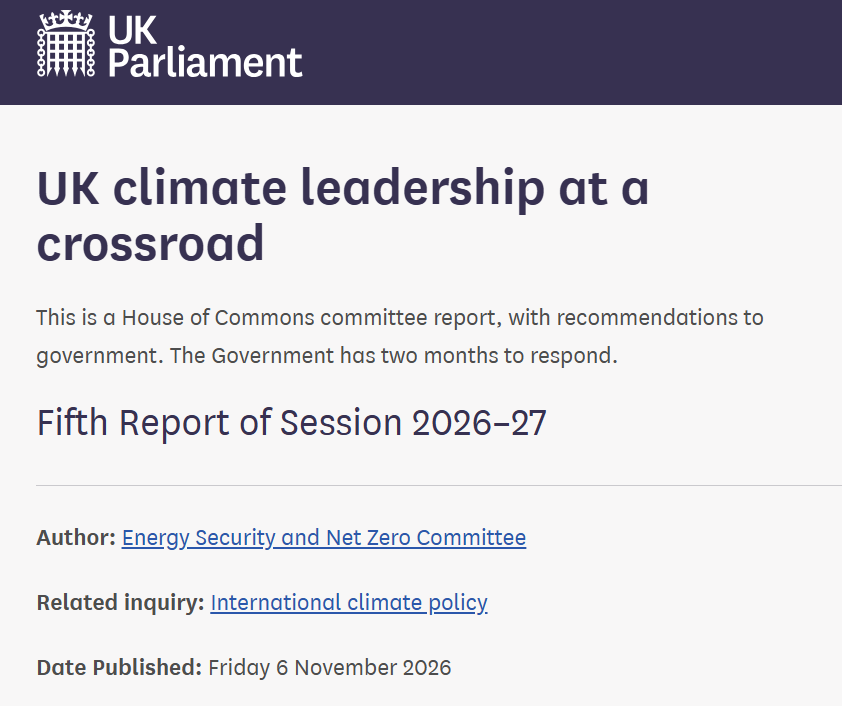
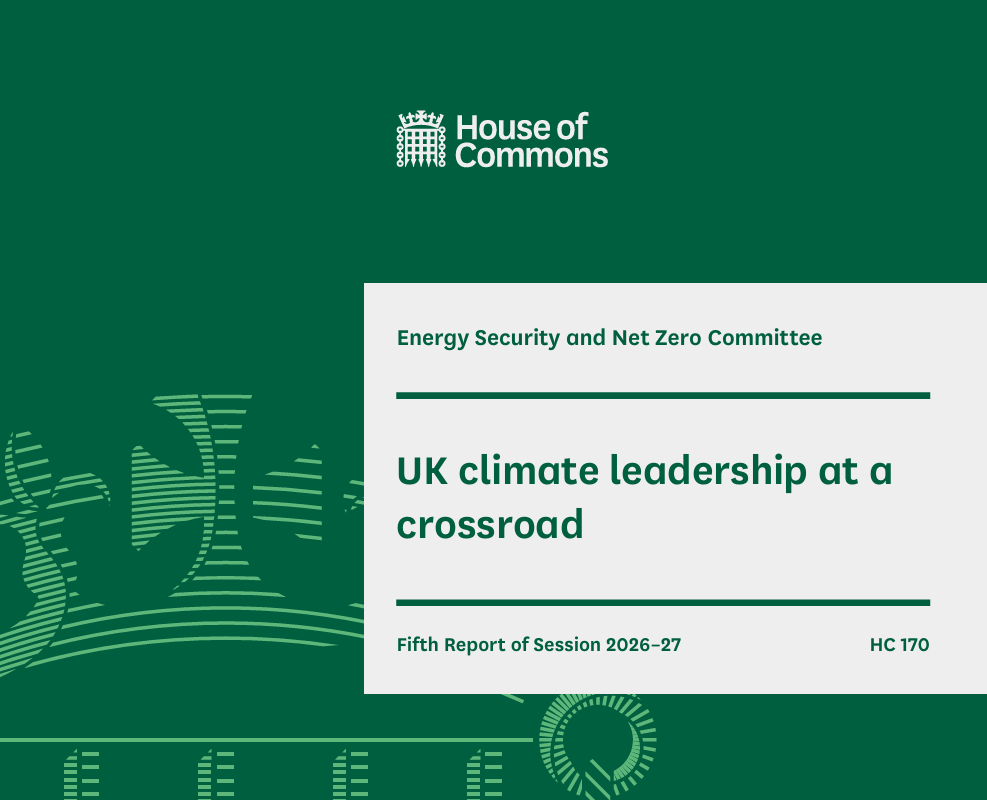
Research conducted at the CCE is featured in the 6 November 2026 House of Commons committee report, UK climate leadership at a crossroad. Evidence submitted by Dr Karen Barrass and team as part of the Locally Determined Contributions (LDC) project – which ran at the CCE between February 2024 and June 2026 – has been used in the Energy Security and Net Zero (ESNZ) Select Committee’s report published in reference to its inquiry on international climate policy.
Select committee reports inform how Parliament and the UK government approach policy, including the UK’s engagement in international climate negotiations. ESNZ in particular scrutinises the policy, spending and administration of the Department for Energy Security and Net Zero (DESNZ) and its public bodies, which includes Ofgem and the Climate Change Committee. By drawing on the LDC project’s findings, the ESNZ Committee has placed locally grounded evidence at the centre of a national conversation about what credible climate leadership looks like. It demonstrates that research on how communities and local actors contribute to climate goals can inform decisions at the highest level, which reflects the CCE’s commitment to producing and supporting work that moves beyond the academic sphere and has a tangible impact on policy and public life. As of June 2026, work to grow the use and impact of the LDC Toolkit now continues under Climate Insights.
The UK government is expected to publish its response to the report at the start of 2027. The LDC team will be following this closely and sharing further information and updates on the Framework’s policy progress on the LDC Toolkit website.
Reference to Dr Barrass and team’s work is quoted below [pg.12 of report]:
“We heard that local delivery is essential to both national and international climate credibility. Evidence we received outlines several proposals to enable local authorities to decarbonise and build resilience to climate impacts. Our previous report “Get connected: How community energy can turbocharge the transition” identified the important role of local authorities and community energy organisations in driving place-based climate actions. Several stakeholders called for more inclusive policy processes at both national and local level to ensure equality, diversity and participation to legitimise effective policies and programmes. The MET Office told us that stakeholder activities can amplify actions signalled by government through policy, especially for adaptation where action happens locally. It suggested a National Framework for Climate Services (NFCS) would strengthen UK leadership in climate action, including with the myriad of stakeholders involved. Prof. Sutton told us an NFCS would establish clear standards for everybody to work within and provide a very powerful mechanism to accelerate adaptation and UK economic leadership. The Centre for Climate Engagement has proposed a ‘Locally Determined Contributions Framework’ to enable local authorities to decarbonise and build resilience to climate impacts. The Minister said this was under consideration.”
For more information on the LDC Framework, please visit the LDC Toolkit website and/or contact Dr Karen Barrass (info@ldctoolkit.org).
Although the initial project was based and driven by partners across Cambridgeshire, it is anticipated that the resulting framework will serve as a model for local authority roadmaps nationwide. CCE worked with the following partners to create the framework: Cambridgeshire and Peterborough Combined Authority, Cambridgeshire County Council, Cambridge City Council, Peterborough City Council, East Cambridgeshire District Council, Huntingdonshire District Council, South Cambridgeshire District Council, and Collaborate CIC.
